New Mexico desert at dusk with a lit workshop

Impact Story · Capital Readiness · New Mexico

Building a stronger path to capital for New Mexico small businesses

Explore the story

Program Evolution · New Mexico

From Workshops to Capital Access

New Mexico EDD and Revby transformed an earlier workshop-led initiative into Capital Connect, a bilingual cohort that combined financial education with individualized consulting, helping business owners move from learning about funding to confidently pursuing the right capital opportunities.

80+ Applications received

Cohort Engagement

Personalized support replaced one-size-fits-all workshops

Rather than ending with a workshop, Capital Connect paired participants with individualized consulting to strengthen financial systems, clarify funding readiness, and help each business identify its next step toward capital.

20 / 19 Selected / Participated

Program Impact

Measurable results. Lasting opportunity.

Capital Connect helped business owners build stronger financial foundations, improve funding readiness, and turn personalized guidance into meaningful capital outcomes across New Mexico.

$1.3M Approved financing

At a glance

Client
New Mexico Economic Development Department — Justice, Equity, Diversity & Inclusion Office
Program
Capital Connect
Funding context
State Small Business Credit Initiative Technical Assistance Program, funded by the U.S. Department of the Treasury
Geography
Statewide, New Mexico
Program period
FY 2025–2026; three-month cohort
Participation
20 for-profit small businesses selected; 19 participated in technical assistance
Priority population
Very small, underserved, minority-owned, rural, and Spanish-speaking businesses ready to strengthen financial systems and pursue responsible growth
Delivery
Virtual kickoff, two financial workshops, individualized consulting, and capstone/graduation experience
Revby role
Program adaptation; bilingual recruitment and selection support; curriculum and workshops; individualized financial and accounting TA; outcome documentation

New Mexico’s SSBCI initiative revealed that many small businesses needed more than access to funding. They needed stronger financial records, clearer capital planning, and the confidence to pursue the right next step.

  • Incomplete or inconsistent records made it difficult to understand business readiness.

  • Growth goals were not always translated into a clear funding amount or purpose.

  • Businesses needed support connecting projections, repayment capacity, and lender expectations.

Insight

Financial education built knowledge, but not always business readiness.

“The program demonstrated that technical assistance works best when it goes beyond a generic curriculum—providing disciplined, expert guidance tailored to the real decisions each business needed to make.”

Earlier phase

Workshop-led access to financial and accounting education

What implementation revealed

Understanding a concept in a workshop is different from applying it to one company's books.

Capital Connect

Workshops remained part of the model, but one-on-one consulting became the core intervention.

Instructor leading a financial basics workshop for small business owners
Business owner reviewing financial reports and charts at her desk
Consultant meeting one-on-one with a business owner

Useful concepts and broad reach

Concepts did not automatically become forecasts, capital plans, or lender-ready financial records.

Practical deliverables were built around each business owner's real priorities, timelines, and next funding decision.

  1. Earlier phase

    Workshop-led access to financial and accounting education

    Instructor leading a financial basics workshop for small business owners

    Useful concepts and broad reach

  2. What implementation revealed

    Understanding a concept in a workshop is different from applying it to one company's books.

    Business owner reviewing financial reports and charts at her desk

    Concepts did not automatically become forecasts, capital plans, or lender-ready financial records.

  3. Capital Connect

    Workshops remained part of the model, but one-on-one consulting became the core intervention.

    Consultant meeting one-on-one with a business owner

    Practical deliverables were built around each business owner's real priorities, timelines, and next funding decision.

Revby responsibilities

What Revby Was Responsible For

Capability 01

Program strategy and adaptation

Applied lessons from the earlier workshop model to design a more targeted cohort experience with individualized support.

Capability 02

Bilingual access and selection support

Supported program positioning, application questions, Spanish-language review, scoring, and participant communications.

Capability 03

Curriculum and facilitation

Delivered the kickoff, bookkeeping and financial fundamentals learning, capital-path synthesis, and capstone experience.

Capability 04

Individualized consulting

Worked directly with books, accounting systems, statements, forecasts, growth scenarios, use-of-funds needs, and capital decisions.

Capability 05

Practical deliverables

Produced or supported financial models, bookkeeping improvements, projections, business plans, lender narratives, and next-step recommendations.

Capability 06

Outcome learning

Documented readiness patterns, financing pathways, implementation lessons, and recommendations for future cohorts.

Testimonial

“They’ve been leading much of that on-the-ground implementation of our program. They’re the ones meeting with the entrepreneurs where they’re at … to provide that tailored support.”

Every business started from a different place

Each participant received practical, business-specific support—from financial foundations to growth planning—based on where they were in their capital readiness journey.

  1. Reliable records

    Organize books, accounts, categories, and reconciliations

  2. Financial clarity

    Interpret margins, cash flow, profitability, and owner compensation

  3. Capital plan

    Define amount, use, timing, structure, and expected return

  4. Funding readiness

    Build projections and a credible narrative—or determine that financing should wait

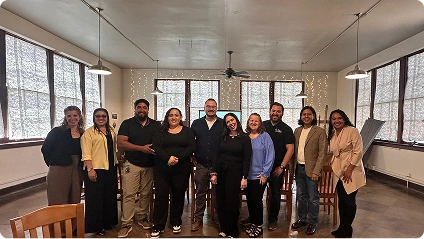
Capital Connect participants and facilitators standing together in a meeting room
A cohort environment designed for participation rather than a one-way webinar.
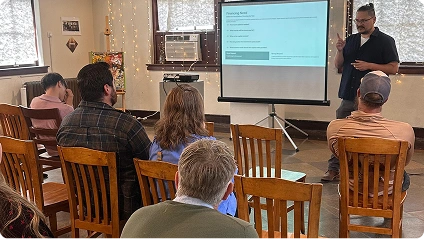
Facilitator presenting financial concepts on a screen to a group of business owners
Applied instruction connects financial concepts to the amount, purpose, timing, and implications of financing.
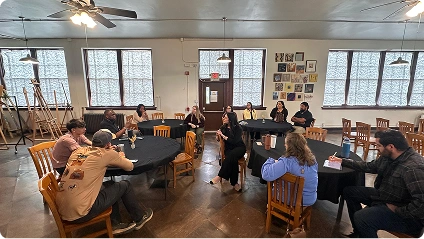
Business owners talking in small groups around round tables
Facilitated dialogue and peer exchange help owners test assumptions and identify next steps.

Progress Along the Capital Path

At closeout, all 19 participating businesses had a documented financing-path status. Their positions demonstrate why a single capital total cannot describe the full value of capital-readiness technical assistance.

$1.3M approved Approved for 123 Child; disbursement pending confirmation.
3 seeking Near-term interest with supporting analysis.
7 preparing Building systems, history, or documentation.
7 not seeking now No present debt need or borrowing appropriately deferred.
1 non-debt path Grant or another non-debt route better fit.

A Diverse Group of Businesses

Supporting a wide range of entrepreneurs and businesses across diverse communities.

  • 80 Applications Received
  • 20 Businesses Selected
  • 19 Businesses Participating in TA
  • 68% Women-Owned or Led
  • 63% Minority-Owned
  • 42% Low-Income Owners
  • 89% Women- and/or Minority-Owned
  • 131 131 employees | 18 businesses

What changed

Business Capability

  • Improved bookkeeping structures, account organization, categorization, reconciliation practices, and accounting-system use.
  • More usable financial statements and a clearer understanding of margins, cash flow, profitability, and owner compensation.
  • Business-specific projections and scenario models for hiring, equipment, inventory, facilities, refinancing, and growth.
  • More disciplined capital narratives linking a defined amount and use of funds to timing, expected return, and repayment capacity.

Capital Decisions

  • 123 Child Development Center received approval for $1.3 million in financing; disbursement remains to be confirmed.
  • Three businesses actively seeking financing and seven preparing for future funding.
  • Seven businesses not currently seeking financing, including cases where deferring debt was the responsible recommendation.
  • One business directed toward a grant or other non-debt capital path.

186 children. 31 employees. One decision.

Growth, rising rent, and an underbuilt facility made expansion a critical next step.

$1.3M approved — but the math came first.

Revby built a financial model that helped the owners understand what they could realistically afford.

Teacher playing with building blocks with young children in a classroom at 123 Child Development Center

From loan to long-term plan.

The owners compared scenarios, balanced payroll and cash flow, and approached lenders with greater confidence.

Lesson for Economic Development Leaders

Effective technical assistance turns financial data into informed funding decisions.